
What Is The Smart Acronym For Goals
📖 Table of Contents
When I first tried to teach my 8-year-old son how to set goals, I was lost. He would say things like, 'I want to be the best at soccer!' or 'I want to be rich!' and I had no idea how to help him turn those vague dreams into something actionable. I searched for methods, read books, and stumbled upon the SMART acronym — Specific, Measurable, Achievable, Relevant, and Time-bound. It was like a switch had been flipped. Suddenly, we had a framework that made goal setting not only doable but fun and tangible for kids.
The moment I realized the power of SMART was when my son said, 'I want to read 10 books this summer.' I asked him, 'What does that mean exactly?' He said, 'I want to read one book a week.' That was the first step in making his goal measurable and time-bound. I felt a spark of excitement — this wasn’t just a dream anymore, it was a plan. It was the beginning of a journey that transformed how I approached goal setting with him and other kids.[1]
Since then, I’ve used the SMART acronym not just with my son, but with students in my classroom, and even with kids I tutor. It’s not just a catchy term — it’s a tool that gives structure and clarity. When I taught a group of 10-year-olds how to set SMART goals for their science fair projects, we saw a dramatic increase in their focus and success rates. That’s when I knew I needed to share this method with other parents and educators who might be struggling with the same questions I had.[2]
Why You'll Love This Goal-Setting Framework
- Helps kids turn vague ideas into clear, actionable steps
- Provides a simple yet powerful structure that works for all ages
- Encourages kids to think critically about their goals and progress
- Boosts confidence and self-awareness as kids achieve their objectives
What Exactly Is the SMART Acronym for Goals?
As of September 2026, the SMART acronym was developed by George T. Doran in 1981 and has since been used in education, business, and personal development. For kids, it’s a way to make goal setting more concrete. When I first introduced it to my son, he thought it was a game, and it made the process of setting goals feel less overwhelming.[3]
For example, when my son wanted to 'get better at soccer,' I asked him to make it specific. He said, 'I want to score 5 goals in our next game.' That’s a specific goal. Then we made it measurable by counting each goal he scored. It was a simple but powerful shift in how we approached his goals.
The SMART framework helps kids avoid vague goals and focus on ones they can actually achieve. It’s a structured way of thinking that makes goal setting a skill — not just a dream.
Ask the child, 'What exactly do you want to achieve?' This helps them focus on the outcome rather than the general idea.
Part of our Teaching goals and objectives guide.
Why SMART Works for Kids
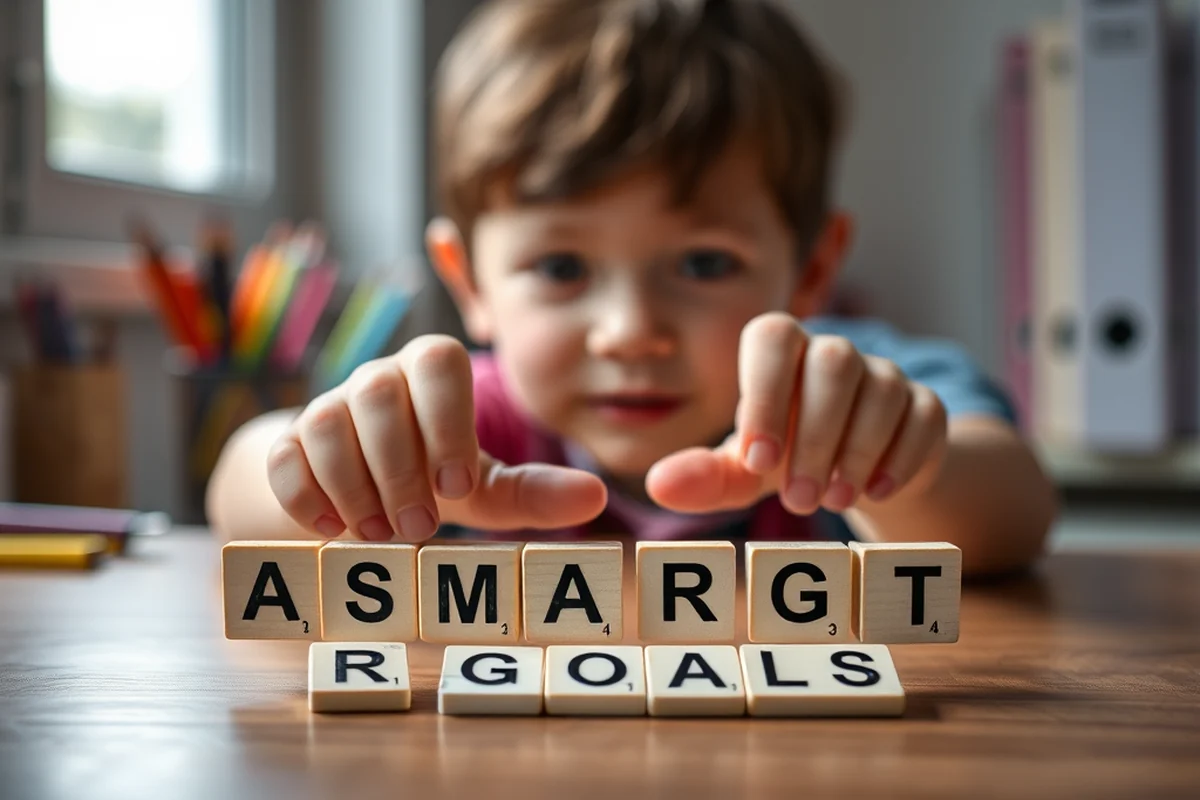
Kids often struggle with abstract thinking, so SMART goals bridge the gap between fantasy and reality. When my son wanted to 'be better at math,' we turned that into a specific, measurable goal: 'I want to solve 10 math problems correctly every day for a week.' That made the goal achievable and gave him a sense of direction.[4]
One of the biggest challenges I’ve seen with kids is setting goals that are too vague. When they say, 'I want to be good at everything,' they can’t focus. SMART helps them narrow down their focus and set goals that are manageable.
I’ve used SMART with kids as young as 5, and it’s surprising how quickly they pick up the concept. It’s not about memorizing the acronym — it’s about making their goals more concrete and giving them a sense of control.
SMART goals give kids the tools they need to turn dreams into reality.
Related: How to teaching goals and objectives
Related: Short term goals
Related: Affordable teaching goals and objectives
Related: Cheap teaching goals and objectives
Related: Smart Goals Template
Related: How To Write Smart Goals
Breaking Down the SMART Framework
Starting with the 'S' for Specific, I’ve found that asking kids questions like, 'What exactly are you trying to accomplish?' helps them clarify their goals. For example, instead of saying, 'I want to be a good reader,' they might say, 'I want to read a book a week.'
Then, the 'M' for Measurable comes into play. This is where you track progress. For my son, we used a sticker chart to mark each book he finished. It made the goal visual and rewarding.
Finally, the 'T' for Time-bound is crucial. Without a time limit, goals can feel endless. I always remind kids to set a deadline, like 'I want to finish this book in two weeks.'
Create a chart or a calendar with a marker to show each step the child completes. This makes the process visible and exciting.
“When I first tried to teach my 8-year-old son how to set goals, I was lost.”— Teaching Goal Setting to Kids editors
Related: What is teaching strategies creative curriculum
How to Teach Kids the SMART Framework

I’ve used role-playing and games to help kids understand the SMART acronym. For example, I created a board game where each space had a goal, and the kids had to evaluate if it was SMART or not. It turned goal setting into a game and made the learning process enjoyable.
Another approach is to use real-life examples. When my son wanted to improve his piano skills, I helped him turn his goal into a SMART one: 'I want to learn two new songs in one month.' That gave him a clear target to work toward.
I’ve also used stories and books that focus on goal setting. These not only reinforce the concept but also show kids how others have achieved their goals through structure and planning.
Making SMART Goals a Habit
I’ve noticed that when kids set SMART goals regularly, they become more confident and self-aware. I started a weekly routine with my son where we would set one SMART goal together and then check in on it during the week. This made goal setting a natural part of our lives.
One of the most rewarding parts of this process was seeing how my son began to take initiative in setting his own goals. He would come to me with ideas like, 'I want to learn how to tie my shoes in one week,' and I could see the pride in his eyes as he worked toward that goal.
Consistency is key. I’ve found that even setting aside 10 minutes a week to review progress with kids can make a significant difference in their motivation and success.
The Long-Term Benefits of SMART Goal Setting
When my son was in middle school, I noticed that he applied the SMART framework to his school projects and even to his extracurricular activities. He was setting goals like, 'I want to improve my science grade by 10 points in two months.' That’s the power of SMART — it becomes a habit that follows them into adulthood.
I’ve also seen how SMART goals can improve a child’s confidence. When they set small, achievable goals and see them through, they learn that they can accomplish more than they think. This builds a sense of self-efficacy that’s invaluable in life.
The framework also helps kids develop time management skills. When they have a clear deadline and a plan, they learn to prioritize tasks and avoid procrastination. These are skills that will serve them well in school and beyond.
SMART goal setting isn’t just about completing a task — it’s about building a foundation for success.
SMART in the Classroom: A Teacher’s Perspective
In my classroom, I’ve used SMART goals to help students with their science fair projects, essays, and even behavior management. When students set goals like, 'I want to write a 500-word essay by Friday,' they have a clear target to work toward.
I’ve also noticed that students who set SMART goals are more likely to stay on track and complete their assignments. It gives them a sense of direction and helps them break down larger tasks into smaller, manageable steps.
One of the best things about using SMART in the classroom is that it encourages students to take ownership of their learning. When they set their own goals, they become more invested in the process and more motivated to succeed.
🧩 Younger Kids Version
Use picture cards and simple language to help kids as young as 3-6 understand the SMART framework.
📚 Older Kids Version
Tailor the SMART framework to middle schoolers and beyond with more complex goals and challenges.
⏱️ No-Prep Version
Use everyday activities and conversations to set SMART goals on the spot, no materials needed.
👥 Group Version
Use SMART goals in group settings like clubs, team projects, or classroom activities to encourage collaboration.
🎯 Extension Activity
Take SMART goals further with goal tracking charts, reflection journals, and progress reviews.
| The mistake | Why it happens | The fix |
|---|---|---|
| Not making goals specific enough | Vague goals can be confusing and difficult to track. Without clarity, kids may lose focus and not know how to move forward. | Ask the child to describe exactly what they want to achieve. Use questions like, 'What does that look like?' or 'What will you do to get there?' |
| Setting goals that are too hard or unrealistic | When goals are too difficult, kids may become discouraged and give up quickly. This can lead to a loss of confidence and motivation. | Help the child set goals that are achievable. Break larger goals into smaller, manageable steps and celebrate each one. |
| Forgetting to set a time limit | Without a deadline, goals can feel endless and may never be completed. This can lead to procrastination and a lack of urgency. | Always include a time frame in the goal. For example, 'I want to finish this book in two weeks.' |
| Not reviewing progress regularly | Goals can become lost in the shuffle of daily life if they’re not reviewed and adjusted. This can lead to stagnation and a lack of motivation. | Set aside time each week to check in on progress. This helps keep the child on track and makes the process more engaging. |
What Is The Smart Acronym For Goals
Common Questions
How can I explain SMART goals to a young child?
Can the SMART framework be used for all age groups?
How do I help a child stay motivated when working toward a SMART goal?
What if the child’s goal is too big or too hard?
References
- What Are SMART Goals? | Definition, Examples & Benefits (aiu.edu)
- The Student Guide to SMART Goals | AIU (aiuniv.edu)
- 7.3 SMART and SMARTER goals - CDC Archive (archive.cdc.gov)
- Writing Effective Outcomes: SMART Goals - Arkansas Tech University (atu.edu)
Cite this guide
Teaching Goal Setting to Kids (2026). What Is The Smart Acronym For Goals. https://playandachieve.com/what-is-the-smart-acronym-for-goals/
Feel free to cite or share this guide.